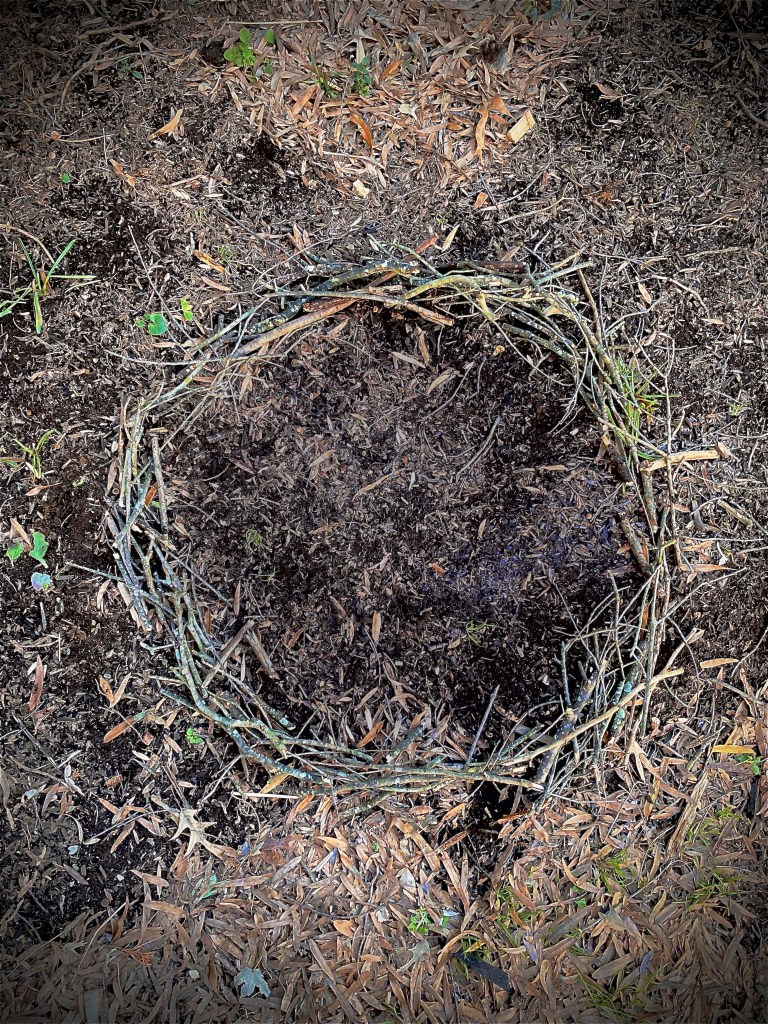
This isn’t my story, but my sister told me this a long time ago so I feel like I have the right to appropriate it. When she was in art school, she went to a park with one of her sculpture classes. When they reached an open area, the teacher told everyone to gather sticks and place them in a big circle. When the circle was complete, she said, “you just made a space.” And with those words, the space inside the circle of sticks really did seem suddenly special or sacred. This was a lesson in positive and negative space, but beyond that, it is also about imparting meaning on a space. This is what a garden can do. But with this power of defining space comes the power to include and the power to exclude.
Another nonscientific anecdote: I live on a small peninsula that’s about four blocks wide. The waterfront houses on the perimeter of course claim rights to surrounding trails and beaches, and there are only a handful of access trails that are easements that supposedly any human is allowed to walk on. The HOA and “improvement association” that claims that only their residents are allowed access to the beaches stuck Keep Out signs to remind you that they have colonized this land and made it all “private.” Such a tasteful “improvement.” And they must have a whole inventory of those KEEP OUT signs because they are continually vandalized and replaced. In one spot, they actually stuck three signs facing different directions in case you didn’t get the point.
Several of the paths outside the boundaries of this imaginary HOA zone are easements that are city or state land to which everyone has access. One path that leads down to a pier was overgrown with English ivy, fallen trees, and thorny bramble. A very lovely and community-minded neighbor somehow managed to have much of the path cleared for one of these trails and she put a bench with two urns full of coleus on either side of it at the entrance. A well-meaning person also stuck two doomed hostas in the ground nearby.
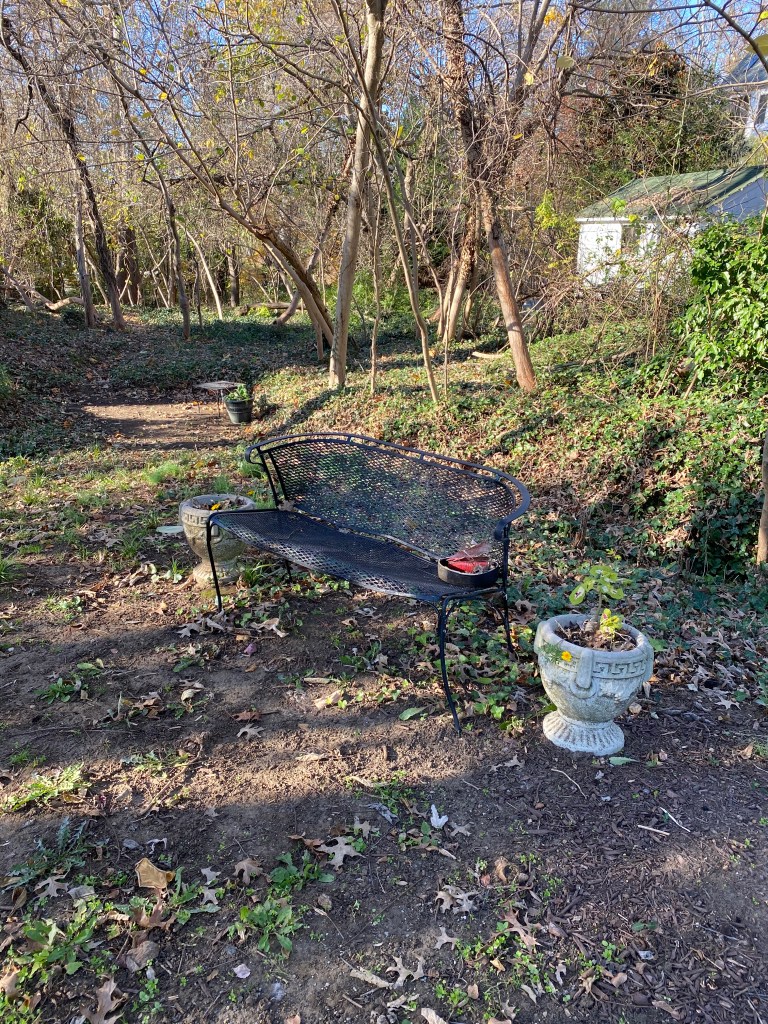
Only a day after this space was created, I was walking down the street toward it. I saw a lady up ahead turn into the path and sit on the bench. As I passed by her I saw that she was talking on the phone to a trebley voice that asked how someone was doing, and the woman replied haltingly, “she passed away yesterday.” And then silence and she just sat on the bench and I continued on my way.
If that bench wasn’t there, where would she have made that phone call? It was a call she had to make in private away from other people, but in a place where she could have silence and reflection.
If you make a Garden space, no matter how small, no matter how few things there are to signal that this is a place of introspection, it becomes a mirror of the world, like a stage that both reflects and reacts to the world around it. And people, whether they know it or not, enter the space to look at the world through a refracted lens. It’s private and public at the same time. By defining the space as a garden it draws a line that connects it to the larger natural world, and it becomes a symbolic place of healing and reflection. All it took was a bench and two urns, or a circle of sticks to create a space to contain the human stories that people bring within it to celebrate, to commemorate, to reflect, and to heal. And this is why no land should be off limits to all but the select few who benefit from the structural advantages to have somehow purchased access to it. In the best of all possible worlds, no land should be off limits. All land has the potential to become a space of healing. If an “Improvement Association” truly wants to improve things, they should take those signs down so there would be nothing for teenagers to kick over. Unless they truly feel it’s okay to live in the best of all possible worlds, while everyone else is shoved outside the circle.
 Heart of the Garden
Leave a comment