I know. Everything is on Native land. I just thought this occasion called for some clickbait.
I was digging up my circle in the front yard and my shovel hit something crunchy but compact. I moved the shovel back a few inches and the metallic crunch resisted my intrusion even more aggressively. Hmmm. I move the shovel down a foot and yet again. So I dug in and see-sawed up a huge chunk of clay and I saw a stripe of darker clay in the deeper layer that was dotted with chips of something gray and white. I poked around the dirt with my knife and popped out a huge oyster shell. I thought it was the remains of someone’s dinner. And it may have been, but probably not the image of the fancy, expensive oyster-eater at a five star boîte that first popped into my head. I couldn’t dig up too much of the front yard without disturbing the shrubs I’d planted, but as I moved along the circle I popped out more and more beautiful, chalky and weathered oyster shells. It felt like I’d unearthed some kind of old magic. But I also rudely disturbed this potentially ancient cache of evidence of human life that had been wedged under the sand and clay for centuries.
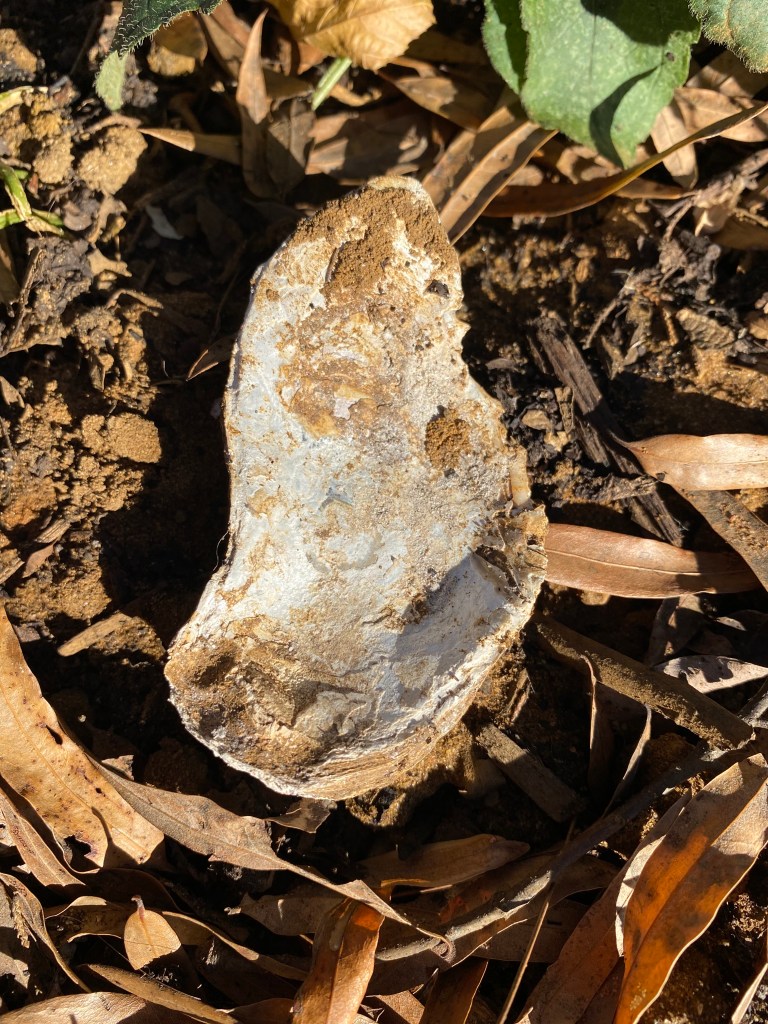
It is not certain that is evidence of an actual oyster midden (I recently learned that this word is not used to describe oyster caches because it implies refuse. I always had second thoughts about this word, but you rarely hear or read it in any other context. But let it be known, oyster shells would and should be valued as a medicinal gift and not referred to as a pile of refuse. Words! So tricky sometimes.)
I contacted the Smithsonian Environmental Research Center’s Environmental Archaeology Laboratory (SEAL) Citizen Science contact page, and they very kindly replied with a very thoughtful, thorough response right away. They explained that it could either be archaeological or geographical.
Here is their response:
“We find oyster shells embedded in Cretaceous era sandy clays (greenish, glauconitic material). If that is what you have, it is geological and not archaeological. Of course, it could be shell midden from anytime dating back about 3,000 years to the present.
As to local Native Americans, they have been around here for at least 10,000 years, during which time there likely have been many groups calling themselves a variety of names in as many languages. For the past millennium or so, we are fairly comfortable assuming those in what is now Southern Maryland were Algonkian speakers (a large language group), but trying to identify a specific tribe is all but hopeless, even since European contact. Native American groups were far more fluid than the term “tribe” captures, groups dividing and then combining with other groups.”
So it would take a lot of digging to find out if the oyster cache is geological or archaeological, but it’s so great to have an actual response from an actual scientist who can also speak to the native groups in the area. It is very difficult to get solid data around this and a true honor to have this story to tell. I hope there’s a part two sometime soon!
 Heart of the Garden
Leave a comment