“Your garden is a protest. It is a place of defiant compassion. It is a space to help sustain wildlife and ecosystem function while providing an aesthetic response that moves you. For you, beauty isn’t just petal-deep but goes down into the soil, farther down into the aquifer and back up into the air and for miles around on the backs and legs of insects. You don’t have to see microbes in action, birds eating seeds, butterflies laying eggs, ants farming aphids… Your garden is a protest for all the ways in which we deny our life by denying other lives. Plant some natives. Be defiantly compassionate.”
― Benjamin Vogt, A New Garden Ethic: Cultivating Defiant Compassion for an Uncertain Future
I found this quote in my notes after planting 676 bulbs today. Spring bulbs. The usual muscari, narcissus, tulips, allium. They were super cheap at LIDL and it set off a dopamine cascade of dirt witch indulgence that is still firing up my brain even after louder priorities and distractions ended my bulb planting frenzy. This is how I usually garden. In the margins of the day otherwise crowded with errands and administration and signup geniuses, and everything that snags you like walking through a pricker bush.
I used a giant step shovel to cleave up chunks of ground and tossed the bulbs in there like tiny bowling balls without any regard for up or down. I figure the roots know what direction to grow in. Slapdash is better than not-at-all. If I didn’t plant the bulbs too far down in the clay, they will hopefully bloom into a big bright advertisement in the spring that says “LOOK at these flowers. Flowers are PRETTY!” And people will say “Oh, I thought that garden was a mess, but look, it makes sense now.” And it will make sense to them for two, maybe three weeks tops, while early spring has everyone on their best behavior. Even though none of these bulbs is native, none of them really provides any services other than flying the flag of spring beauty. It’s a media campaign I can support because for all the delayed gratification of planting bulbs in the fall, you get a guaranteed burst of color when you need it most. I am putting the biggest spring spectacle in the front for passersby.
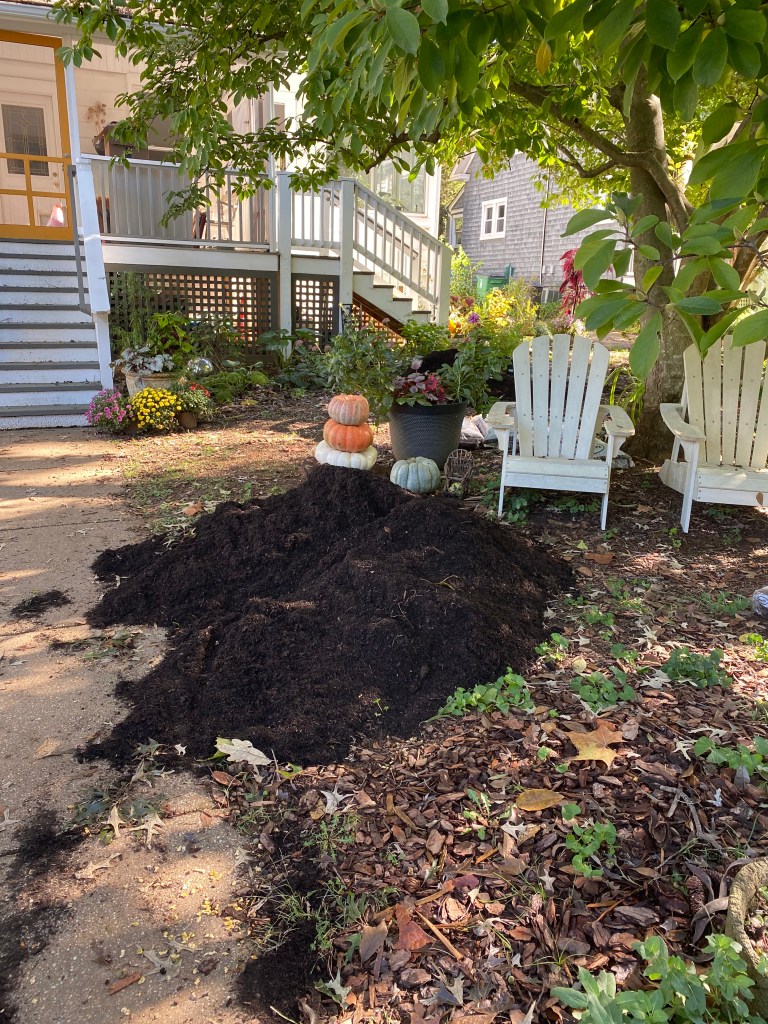
It is sometimes uncomfortable gardening in the front, contorting into awkward, borderline profane yoga poses to get things in the ground. (Downward facing dirt witch.) And your grunting-est and most fatroll-exposing efforts are on full display prompting people to comment on how “hard” you’re working. I often get a perplexing fragment, mostly from men: “…lotta work!” And I often react with a compulsory “it’s a work-in-progress!” Which has a built-in apology. A sorry for appearing like I don’t care about property values. Sorry I appear like I don’t care about curb appeal. Sorry I appear like I’m not aligning with your values of convenience and leisure by putting my manual labor on full public display. I live in your neighborhood and I’m behaving like a common laborer and what does that say about the neighborhood? What does that say about you? I should be embarrassed about that. And my real feeling is somewhere between actual embarrassment and defiant anger.
I am constantly apologizing for my garden. I’ve had it for about a year and a half and I’ve poked at every inch of it. Half of the front yard is part sun and the other is full shade. I became fixated on the idea of a circle in the sun to maximize the border area, to make you walk into the space and turn around in it to really look at the plants and, of course, listen to me explain them all in detail. I had visions of giving tours to a whole parade of imaginary native plant enthusiasts, ladies in linen with fiber arts degrees.
I thought some kind of water feature would work. Initially I envisioned a plain ceramic or hypertufa bowl full of water in which we could float leaves and flowers, but we ended up with a real fountain. I’m waiting for the rest of the garden to tell me what it wants to be. It was a wasteland of knockout roses, liriope, ivy, orange daylilies, aucuba, creeping charlie, euonymus, and a giant climbing hydrangea over a chain link fence from the 70s. All gone. But for the relentlessly opportunistic root scraps of creeping charlie, liriope, and ivy.
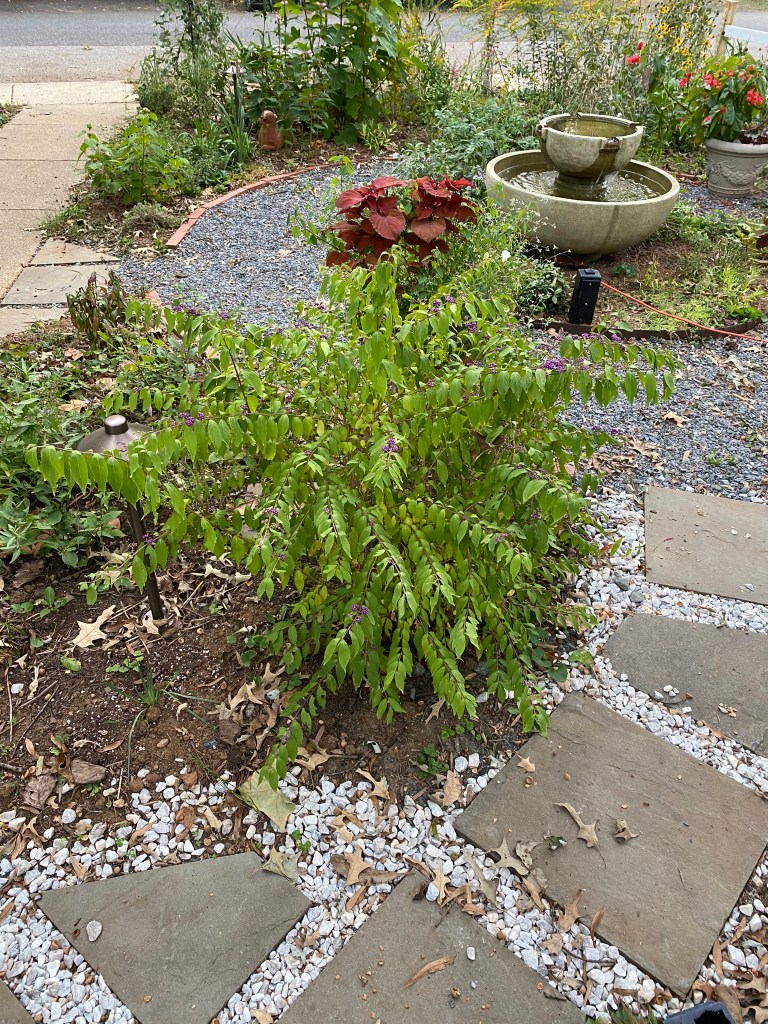
When you start a garden by yourself on a budget, it’s hard to fill in all the spaces at once. You have a conversation with the dirt, sun, your budget, all the local garden centers (assuming there are good ones) and mail order suppliers and you plant things as you go through the seasons and nothing is ever finished. You look at it like a cubist painting, through a kaleidoscope of seasons. You see layers of time, invisible growth patterns, future blooms and entropy in one Matrix-like visual sweep. Sometimes I have to shake off that lens and try to look at it for what it really is, from the perspective of the sidewalk, from the perspective of a person on the sidewalk who has no idea what they are looking at except that it’s not the sidewalk. And I realize how blind I can be. I don’t see the rangy, dried up stalk of Lobelia siphilitica as a rangy, dried up stalk. To me it looks like a beautiful brown bounty of seeds, a bird perch, and eventual compost. I think it looks GREAT! But I know my neighbor with the lawn and the poison warning signs is horrified by it and wonders “how hard can it be to just cut that down?”
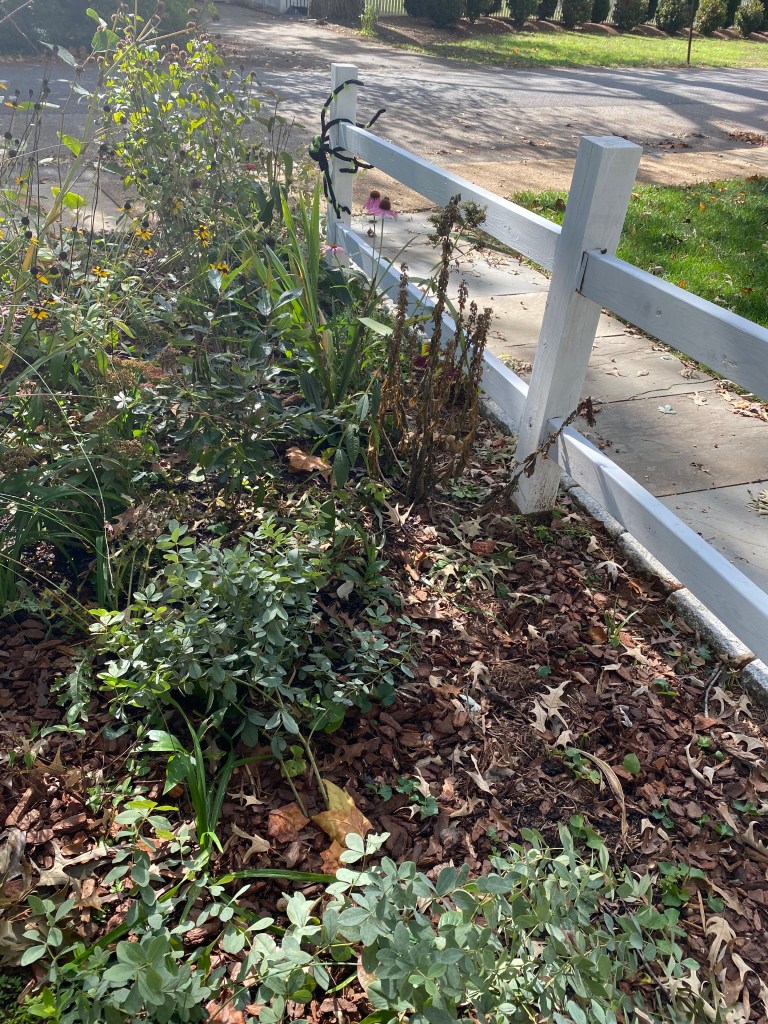
Yet another layer of conversation going on in my head with my garden: Garden, I say, I want people on the sidewalk to like you. So they don’t let their dogs trample and pee all over you. And maybe you’ll even give them some mild spark of inspiration to bring some color to their own patch of grass. Whether you like it or not (and you DO) you are engaged in garden PR.
But I also need to be resiliently defiant about my own gardening ethos because my garden is the physical manifestation of my identity and my conscience (as well as my white, middle class privilege to actually have a garden). People don’t know what an intimate and visceral space this is. It’s an extension of my own organs, my earthen offspring splayed out like an apron. It’s my imagination incarnate. Maybe that’s why I’m always apologizing for imposing such a visceral scene on passersby. Look at my guts right here on full display!
Gardening is one of the few things that reliably makes me hopeful. Hope is such a hackneyed word, I barely know what it means because it implies an adverse state of desperation. But in this context, I get it. Gardening is an act of optimism because it involves so many intersecting processes that connect you to other living things and to future seasons. It means you care what happens next and you care about how other living things are affected by it. To find hope knowing that other creatures are burbling away in seed trays in the basement or seeds are being cold stratified outside over winter as the clock ticks. To know that the clouds moving across the sky are part of this process you’re involved in. Time becomes a solid, real thing, the way leaves animate the wind. All these natural elements are working (lotta work!) clicking along and igniting the genetic code of the bareroots you planted out there in the cold, dormant landscape months ago. All these living things are burbling away (yes, burbling) around you and you feel like a dirt witch conducting some pagan orchestra that will begin to burst through the earth’s crust in a crescendo of life come spring. One quiet attempt to reconnect a small part of this broken web. And maybe even connect you to that odd person on the sidewalk who doesn’t comment on how hard you’re working, but instead gives you a wink and a thumbs up. I see what you’re doing here. I hear the symphony you’re composing. Don’t say sorry. Say thank you thank you thank you.
 Heart of the Garden
Leave a comment